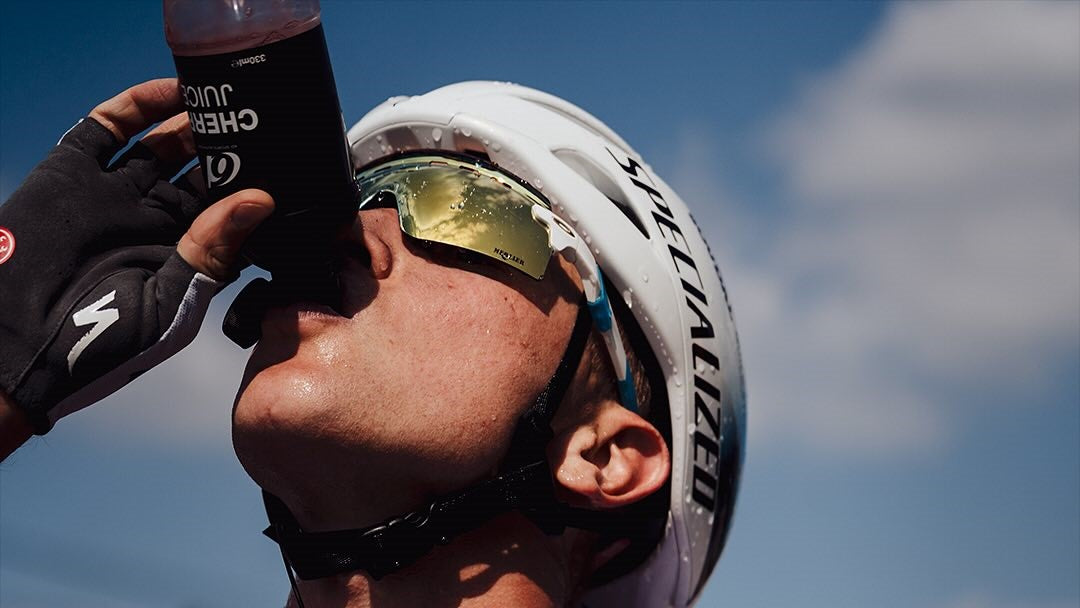
Recovery plays a crucial role in daily performance during the three-week Tour de France. Therefore, teams are constantly looking for ways to stay fresh and recover faster between stages.
An increasingly popular recovery aid is tart cherry juice, made from Montmorency cherries. At the end of stages, when we see teams like Soudal Quick‑Step and EF Education‑EasyPost drinking a dark red liquid, it is indeed tart cherry juice.
Tart cherries are rich in an antioxidant compound called anthocyanins, which gives them their deep red color. These compounds help reduce oxidative stress and inflammation in muscles after intense exertion.
A 2020 analysis of scientific literature found that consuming tart cherry supplements significantly reduces muscle soreness, inflammation markers, and loss of strength after exercise. A 2017 review also confirmed that cherry juice helped reduce muscle soreness and maintain muscle function in endurance athletes, including WorldTour cyclists.
Tart cherry juice not only offers anti-inflammatory benefits but also provides a useful carbohydrate boost. A 240 ml serving typically contains 30–35 grams of carbohydrates. Some teams mix the juice into their recovery drinks along with protein, electrolytes, and additional carbohydrates to support all aspects of recovery as quickly as possible after a stage. This timely recovery is vital when the next day's competition is just around the corner – any missed recovery opportunity can have serious consequences later.
The Tour de France is not just a physical exertion. Riders have to cope with disrupted routines, travel between cities, hotel changes, and mental stress. As a result, sleep quality often suffers. Cherry juice naturally contains melatonin and the amino acid tryptophan, both of which can promote deeper sleep. Studies have shown that consuming Montmorency cherry juice improves sleep duration and quality in adults.
Better sleep supports hormonal balance and the body's recovery processes, which are critical for maintaining peak performance day after day.
Teams like UAE Team Emirates, Visma-Lease a Bike, EF Education‑EasyPost, and Soudal-QuickStep use cherry juice daily during Grand Tours. Riders typically start 'loading' a few days before the race – this means drinking cherry juice twice a day (240–360 ml at a time), for three to seven days prior to the competition.
Once the race begins, they drink a post-stage beverage and an additional serving in the evening to support sleep. Most teams prefer convenient forms such as concentrated liquids or individual sachets, which have a good shelf life and are easy to transport.
Cherry juice is not a miracle cure and has some limitations. Some studies suggest that long-term use of strong antioxidants may hinder training adaptations, particularly the development of mitochondrial efficiency.
During training, several beneficial changes occur due to oxidative stress, free radicals, and hydrogen ions, all of which contribute to muscle damage and inflammation. While excessive and constant levels of these compounds are harmful – hence the justification for antioxidants – they are essential for development when consumed in the right amounts alongside adequate rest.
Therefore, cherry juice is most beneficial during the competition period, rather than for supporting daily training. Another practical concern is the cost. High-quality tart cherry products can be expensive, but at the WorldTour level, this is less of a deciding factor, and they are more affordable compared to ketones.